
South Carolina Property Taxes: 4% vs 6% Grand Strand Guide
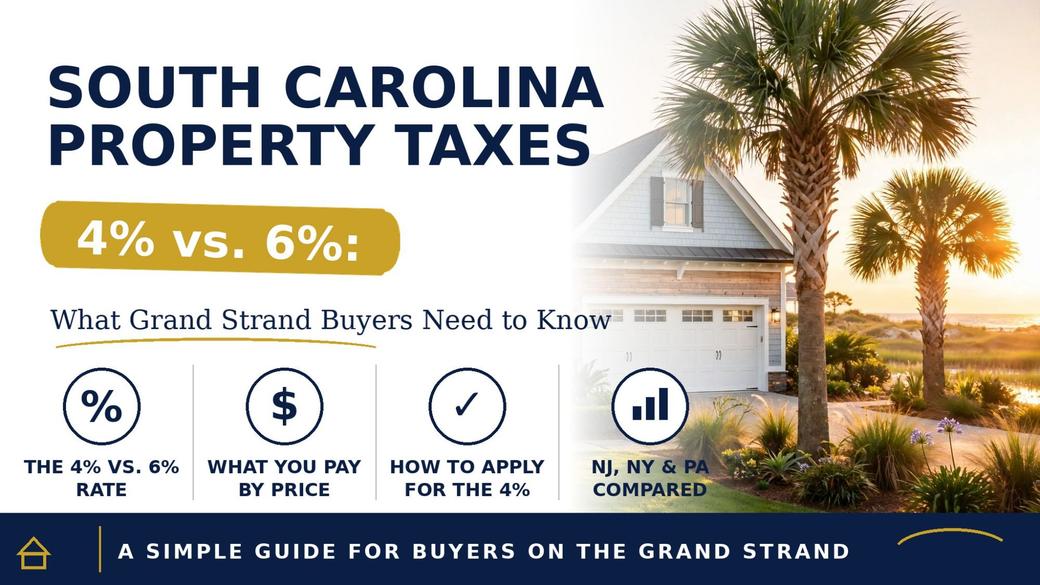
South Carolina Property Tax Rates:
4% vs. 6%: What Grand Strand
Buyers Need to Know
How SC’s two-tier property tax system can save you thousands annually. And why it changes the math for buyers relocating from NJ, NY, and PA.
Coastal Carolina Group • Myrtle Beach, SC • November 2026
South Carolina taxes owner-occupied primary residences at 4%, much lower than the 6% rate on second homes and rentals. On a $400,000 home in the City of Myrtle Beach, that is about $2,328 a year at 4% and about $6,110 a year at 6%. The same $400,000 home costs about $7,520 a year in New Jersey.
How Does South Carolina Property Tax Actually Work?
South Carolina does not tax your home’s full market value. Instead, it applies an assessment ratio to that value, then multiplies by a mill rate. Owner-occupied primary homes use a 4% ratio; everything else uses 6%. The result is a tax bill that surprises most out-of-state buyers, in a good way.
Here’s the math in plain terms. Take a $400,000 home in Horry County (which covers Myrtle Beach, North Myrtle Beach, Conway, Little River, and Longs). Inside the City of Myrtle Beach, the 2026 millage is 145.5 mills for a primary home and 254.6 mills for a second home. The two rates are different because a second home also pays the school operating tax of 109.1 mills, which a primary home is exempt from.
At 4% (primary residence): $400,000 × 0.04 = $16,000 assessed value. $16,000 × 0.1455 = approximately $2,328/year.
At 6% (second home / investment): $400,000 × 0.06 = $24,000 assessed value. $24,000 × 0.2546 = approximately $6,110/year.
That’s a $3,782 annual difference on the same house, just from which rate applies. Over a 10-year ownership, that’s about $37,800 in savings, before any changes in mill rate or home value. It’s one of the most consequential numbers in a Grand Strand purchase decision, and one that most buyers don’t fully understand until closing day.
Outside the city limits there is no city tax, so the bill is lower. In unincorporated Horry County, a $350,000 home runs about $1,287 a year at 4% and about $4,221 a year at 6%.
Georgetown County (Pawleys Island, Murrells Inlet south) sets its own mill rate. When we work with buyers in Pawleys Island or the Litchfield Beach area, we always run the numbers with Georgetown County’s actual current mill rate so there are no surprises at closing.
How Do Grand Strand Property Taxes Compare to NJ, NY, and PA?
On a $400,000 home, New Jersey runs about $7,520 a year in property taxes. New York runs about $5,200. Pennsylvania runs about $5,040. The same home in the City of Myrtle Beach runs about $2,328 a year at the 4% rate. That is not a rounding error. It is a structural difference that changes retirement math.
| State / Rate | Effective Tax Rate | Annual Tax on $400K Home | 10-Year Tax Cost |
|---|---|---|---|
| New Jersey | 1.88% | $7,520 | $75,200 |
| New York | 1.30% | $5,200 | $52,000 |
| Pennsylvania | 1.26% | $5,040 | $50,400 |
| SC: 4% (Primary) | 0.58% | $2,328 | $23,280 |
| SC: 6% (Second Home) | 1.53% | $6,110 | $61,100 |
Effective rates are Tax Foundation 2026 figures from 2024 Census data. SC figures use Horry County / City of Myrtle Beach 2026 millage (145.5 mills primary, 254.6 mills second home). Actual taxes vary by municipality. Always verify with the county assessor.
Say you pay about $9,500 a year in property taxes in Bergen County, NJ, and you move to a $400K home at Del Webb at Grande Dunes, a newer 55+ community off Robert Grissom Parkway with resort amenities, and pay roughly $2,328. That’s about $7,200 a year back in your pocket for retirement income, travel, or the golf membership you’ve been putting off.
What matters, though, is making sure that 4% rate actually applies. And that requires meeting SC’s legal residency requirements. We cover how to qualify in the next section.
What Does South Carolina Require to Get the 4% Legal Residence Rate?
To qualify for the 4% Legal Residence rate in South Carolina, you must own the property, occupy it as your primary domicile, and not claim a primary residence exemption in any other state. You apply through the county assessor’s office. It is not automatic. Missing the application deadline means paying 6% until you refile.
Here are the specific requirements SC law imposes:
- You must be the legal owner of the property (deed in your name, trust with you as beneficiary, or qualifying LLC structure).
- It must be your legal domicile: your primary, permanent home. You can only have one primary domicile.
- You cannot claim a homestead or primary residence exemption in another state. If you still have a homestead exemption on a property in New Jersey or Florida, you must release it before claiming SC’s 4%.
- You must apply with the Horry County Assessor’s Office (or Georgetown County, as applicable) by the January 15 deadline following the year of acquisition. The county asks you to file by May 31 so your fall tax bill already shows the 4% rate. If you close on October 1 and don’t file by January 15, you’ll pay at the 6% rate for that tax year.
- Supporting documentation typically includes your South Carolina driver’s license or state ID showing the property address, your South Carolina vehicle registration, and redacted copies of your federal and state tax returns. Voter registration helps if you have it.
We flag this application as a closing task for every buyer we work with who is making the Grand Strand their primary home. It is a short process once you have the documentation together. Missing it costs real money.
What about second home / vacation property buyers? If you’re buying in Barefoot Resort or on the Murrells Inlet Marshwalk and this is not your primary home, you’ll pay at the 6% rate. Some buyers initially buy as a second home and then convert to primary when they retire. At that point, they refile and get reclassified going forward.
Does South Carolina Offer Additional Property Tax Relief for Retirees Over 65?
Yes. South Carolina’s Homestead Exemption for residents 65 and older removes the first $50,000 of a primary home’s value from taxation. For 2026 only, that amount is $75,000. On a $400,000 home at the 4% rate, it saves about $290 a year, and about $437 in 2026. You apply once and it continues automatically.
To qualify for the SC Homestead Exemption:
- You must be 65 or older (or permanently and totally disabled, or legally blind).
- You must have owned and occupied the property as your legal residence for at least one full calendar year before applying.
- Application is filed with the County Auditor’s office. First-time applicants apply in person with proof of age or disability. The deadline is July 15 of the first year you qualify.
Stacking the savings: A 65+ buyer on a $450,000 home who qualifies for both the 4% Legal Residence rate and the Homestead Exemption pays tax on ($450,000 − $75,000) × 4% = $15,000 of assessed value in 2026. At 145.5 mills, that’s approximately $2,183 per year. Without either exemption at the 6% rate on full value, the same home would generate a $6,874 bill. The combined savings: about $4,691 per year.
This is the conversation we have all the time with buyers moving down from up north. They tell us what they pay in taxes back home. Then we show them these numbers. The reaction is always the same. The New Jersey median property tax bill is about $9,358 a year. The South Carolina median is about $1,337.
Does South Carolina Tax Social Security or Retirement Income?
South Carolina does not tax Social Security benefits. Residents 65 and older can deduct up to $10,000 of retirement income. They can also claim a $15,000 age-65 deduction against any income, but that $15,000 is reduced by whatever retirement deduction they claim, so the two together total $15,000 at most. South Carolina’s top income tax rate for 2026 is 5.21%, down from 6% in 2025, versus up to 10.75% in New Jersey and 10.9% in New York.
For retirees, the income tax picture in SC typically looks like this in practice:
- Social Security: 100% exempt from SC state income tax.
- Pension income / 401(k) / IRA distributions: Up to $3,000 exempt for taxpayers under 65; up to $10,000 exempt for those 65 and older.
- Age 65 deduction: Up to $15,000 against any South Carolina income, reduced by retirement deductions already claimed, so $15,000 total.
- Military retirement pay: 100% exempt from SC state income tax.
- Capital gains: Taxed as ordinary income, but SC allows a 44% deduction on net long-term capital gains, bringing the effective state rate on most investment income to about 2.9%.
For 2026, South Carolina’s income tax is 1.99% on the first $30,000 of taxable income and 5.21% above that, after the Act 110 reform signed in March 2026. The old top rate of 6% is gone. The combination of low property taxes, Social Security exemption, and retirement income deductions is why we see so many buyers from the Northeast running the full cost-of-living comparison and finding that the annual savings from moving to the Grand Strand more than covers their housing costs. It’s not a tax shelter. It’s just a state that was designed to be affordable for retirees.
Important: Tax law changes. We always recommend that buyers planning a move to the Grand Strand consult with a CPA or tax advisor who understands SC’s rules alongside their home-state obligations before making any major decisions. What we can tell you is what the law says now. What it means for your specific situation requires a licensed tax professional looking at your specific numbers.
How Do Grand Strand Property Taxes Look in Specific Communities?
Your tax bill follows the price of the home you buy, not the name of the community. The cards below show three communities buyers ask us about most, and the table after them shows what different price points run at the 4% and 6% rates.
|
🏖 Del Webb at Grande Dunes
Location: Myrtle Beach (Horry County)
Type: 55+ Active Adult Price range: $400,000–over $1,000,000 Notes: Gated, resort amenities, near the Intracoastal. Many buyers here are making this their primary home and qualifying for the 4% rate. |
🌊 Waterbridge
Location: Carolina Forest, Myrtle Beach (Horry County)
Type: Master-planned community Price range: $400,000–$1,000,000+ Notes: One of the Grand Strand’s most established neighborhoods with lake access and a pool complex. Popular with primary-residence buyers relocating from the Northeast. |
|
|
⛵ Barefoot Resort & Golf
Location: North Myrtle Beach (Horry County)
Type: Golf & marina community Price range: $275,000–$550,000+ Notes: Four championship golf courses, a marina on the ICW, and a mix of condos, townhomes, and single-family homes. Buyers who make this their primary residence qualify for the 4% rate. Those using it as a vacation property or rental pay 6%. |
❓ Looking at Another Community?
Send us the address of the home you like and we will run the exact tax numbers for that home at the 4% and 6% rates, so you can compare with what you pay now before you make an offer.
|
What Different Price Points Run at 4% vs. 6%
The tax follows the purchase price. Use the table below to see what a home costs you at each price point, as a primary home or as a second home.
| Home price | 4% Primary home | 6% Second home |
|---|---|---|
| $300,000 | $1,746 / yr | $4,583 / yr |
| $400,000 | $2,328 / yr | $6,110 / yr |
| $500,000 | $2,910 / yr | $7,638 / yr |
| $600,000 | $3,492 / yr | $9,166 / yr |
| $700,000 | $4,074 / yr | $10,693 / yr |
City of Myrtle Beach 2026 millage (145.5 mills primary, 254.6 mills second home). Your millage varies by location, so the same price point can run lower outside the city limits. We run the exact numbers for any home you are looking at.
How Should the 4% vs. 6% Rate Affect Which Property I Buy?
The 4% vs. 6% distinction matters most when buyers are deciding between making the Grand Strand their primary home versus keeping it a second home. The tax difference on a $450,000 property is about $4,255 a year. What is decisive is understanding which rate will apply before closing, not after.
Here are three situations buyers run into:
The retirement transition buyer. They’re still working but plan to retire in 2–3 years. They buy now, use the property as a second home at 6%, and then switch to 4% when they establish SC domicile. The tax savings at that point are gravy. But they should know the transition process exists and plan for it.
The rental income buyer. They want to put the property on VRBO or Airbnb for a few weeks a year while they’re not using it. Renting can put the 4% rate at risk, and the rules depend on how many days you rent it. If rental income is part of the financial model, budget for the 6% rate and check the rules for that municipality before you buy.
The full relocation buyer. They’re cutting ties completely: selling the northern home, establishing SC domicile, changing driver’s license, registering to vote. This buyer captures the 4% rate immediately and should ensure they file by the January 15 deadline after their closing.
Our team walks through all three scenarios during buyer consultations because the tax picture is part of the financial picture. And getting it right at the start avoids unpleasant surprises later.
Turn your northern tax bill into a price point. Most buyers take the tax bill they pay up north and use it to set the price point they focus on here.
Say you pay $20,000 a year in property taxes up north. The same $400,000 home here at the 4% rate runs about $2,328 a year. That is about $17,672 a year you keep. Buyers put that difference toward a higher price range or toward updating the property they buy.
To put it another way, that $17,672 a year is more than three times the annual tax on a $1,000,000 home here at the 4% rate, about $5,820 a year. The tax savings alone can move you into a different price point.
❓ Frequently Asked Questions
1. How do I apply for the 4% property tax rate in South Carolina?
You apply with the county assessor’s office after closing. The deadline is January 15 of the year following your acquisition year. If you close in August 2026, you must file by January 15, 2027 to get the 4% rate applied to the 2026 tax year. The county asks you to file by May 31 so your fall bill already shows the 4% rate. We remind every buyer we work with and can point you to the right county contact.
2. Can I rent out my primary residence and keep the 4% rate?
Renting can put the 4% rate at risk. South Carolina requires the property to be your legal domicile, and renting it more than 72 days in a year ends the 4% rate. If rental income is part of your plan, consult a SC real estate attorney before assuming the 4% rate will hold. The safest approach is to keep short-term rentals on separate investment properties taxed at 6%.
3. Can I get both the 4% rate and the homestead exemption?
Yes, if you meet the requirements for each. The 4% Legal Residence application can be filed shortly after closing. The $50,000 Homestead Exemption for 65+ requires you to have owned and occupied the property as your legal residence for at least one full calendar year before applying. So you’d typically get the 4% rate in year one and add the Homestead Exemption in year two. For 2026 only, the exemption amount is $75,000.
4. Does South Carolina tax Social Security?
No. South Carolina does not tax Social Security benefits at the state level. New York and Pennsylvania do not tax them either, so the saving here is on property tax and other retirement income, not on Social Security.
5. Can I switch my home from the 6% rate to the 4% rate later?
You’ll pay the 6% rate while it’s a second home, then refile for the 4% rate when you establish SC as your legal domicile. The process is straightforward. Change your driver’s license, voter registration, and release any primary residence exemption in your previous state, then apply with the county assessor. The 4% rate will apply going forward from that filing.
6. Are property taxes different in Pawleys Island vs. Myrtle Beach?
Yes. Pawleys Island is in Georgetown County, which sets its own mill rate. It still uses the same 4% / 6% assessment ratio. When we work with buyers in Pawleys or the Litchfield area, we run Georgetown County’s actual current mill rate so the numbers are accurate.
7. Is there a cap on how much my South Carolina property tax can go up?
SC caps how much your assessed value can rise at a reassessment: no more than 15% over a five-year cycle. This is not a freeze. Your bill can still go up if the mill rate rises. And the cap resets when the home sells. The new owner is taxed on the purchase price.
8. How do South Carolina property taxes compare to New Jersey?
It varies by situation, but the property tax piece alone is large. The median New Jersey homeowner pays about $9,358 a year. The median South Carolina homeowner pays about $1,337. That is a difference of about $8,000 a year before you count Social Security going untaxed and the retirement income deductions. The total varies by situation. We run the exact numbers for you in a no-pressure consultation.
Get a Property Tax Comparison
for Your Specific Situation
Whether you’re considering Del Webb at Grande Dunes, Waterbridge, Barefoot Resort, or somewhere in Pawleys Island, we can run the actual property tax numbers on any specific home you’re looking at. No cost, no obligation. Just straight answers so you can compare with what you’re paying now.
Talk to Our Team →Sources: Horry County 2026 millage, Auditor’s certified levy; SC Department of Revenue, Property Tax Policy Manual, Chapter 5; SC homestead exemption, 2026 ($75,000 for tax year 2026 only); SC income tax 2026, Act 110 (H.4216); Tax Foundation 2026 effective rates from 2024 Census data.
The information provided in this blog post is for general informational purposes only and should not be construed as legal, financial, or tax advice. Property tax rates, mill rates, and exemption thresholds are subject to change. Please consult with a qualified CPA, tax attorney, or SC county assessor for advice specific to your situation.
Information provided for educational purposes. Verify all tax figures with Horry County or Georgetown County Assessor’s Office.
Categories
Recent Posts